
Closing the loop: A cycle of reflection, learning and decision making
Over the last couple of months, our team has been in many sessions, webinars, and talks on evidence, knowledge, and decision-making in the humanitarian, development, and philanthropy sectors. We've been working on these topics for years, but it seems to have recently been making waves when talking about decision-making. We’ve always excitedly shared these invites internally, hoping that maybe this time we’ll find an answer. We enter the sessions and hang on to the hope until the end. However, we’re always left a bit unfulfilled and unsatisfied with the question still remaining: how do organisations, teams and individuals actually make decisions, and how does existing or new knowledge flow into them?
Intuition is not magic
No one has been able to give us a concrete description of this connection between knowledge and decisions, in reality. And yes, there is general research about it. Nonaka has described how knowledge flows through organisations, and so has Kolb. Argyris and Schön’s early definition relies on organisations changing course based on new knowledge and the Norwegian development agency claims that knowledge is key to making decisions. That’s all great, but did we get any closer to the answer of what it actually looks like?
Think about it for yourself. Think back on a recent decision: going way A or way B. What did you choose and why? Maybe it wasn’t that straightforward; it usually never is, but we constantly make decisions, big and small, that determine where a plan goes, how a community might be affected, and how a disaster might be avoided or mitigated after it occurs. Someone recently said: intuition is nothing more than accumulated experience and knowledge. We think it’s a gut feeling, but it doesn’t come out of thin air. We built it. The only thing is that whatever is included in our intuition is biased, based on our personal filters of what information we deem as important and prejudices.
So, intuition is for sure a collection of different insights and different people's stories. However it gets filtered through our own system to make us think that ours is the best decision for a given situation. And we value experience; we think someone who’s been on the job longer, knows better. I’m sure there is some truth to it because, following the logic of collected intelligence, the more experiences = more knowledge = better decisions. However, that person with that much experience might also just be extrapolating their biases in these decisions, further and further going down the wrong path. If you now apply this back to decisions about humanitarian assistance, diplomacy and policymaking, it paints quite a grim picture that if we only think we know right based on our own small field of vision, we might make wrong decisions that affect thousands.
As a start-up, we are building a new solution for a sector we know has a problem we can solve. So, we have strategies and a plan on how to help organisations with our solution while building a self-sustaining business. We operate based on the assumptions we have from experience, conversations and literature. It has similarities to a Theory of Change. We assume that if we show value to organisations in this way, they adopt it. We think that if we improve this piece of UI, it will get easier for users to navigate the platform. We assume that if we push weekly notifications about their lesson reports, users will engage more, etc. We have to test these assumptions with the actual people affected for whom we are trying to make life easier. I am not trying to say that these are the same level of decisions as necessary in a response to a humanitarian catastrophe. I am merely trying to point out the similarities in preconditions.
Learning = old knowledge + new knowledge + decision
From there, we asked ourselves as a team, how do we create rapid cycles of reflections, shared sensemaking and learning? Learning, meaning we’re taking our newly gained knowledge with us into the decision for the next phase.
We always set yearly goals for the different workstreams or teams we have, and then within them, more concise and achievable quarterly outputs. These can be about how many people we want to reach, what communication outputs we want to share or how high the happiness score of users should be. All teams work on their workstreams over the months and quarters. Regularly, they will be asked to note their lessons and new insights in our platform. In the platform, we developed learning questions around our key goals to test our assumptions. Such a question can be, for example:

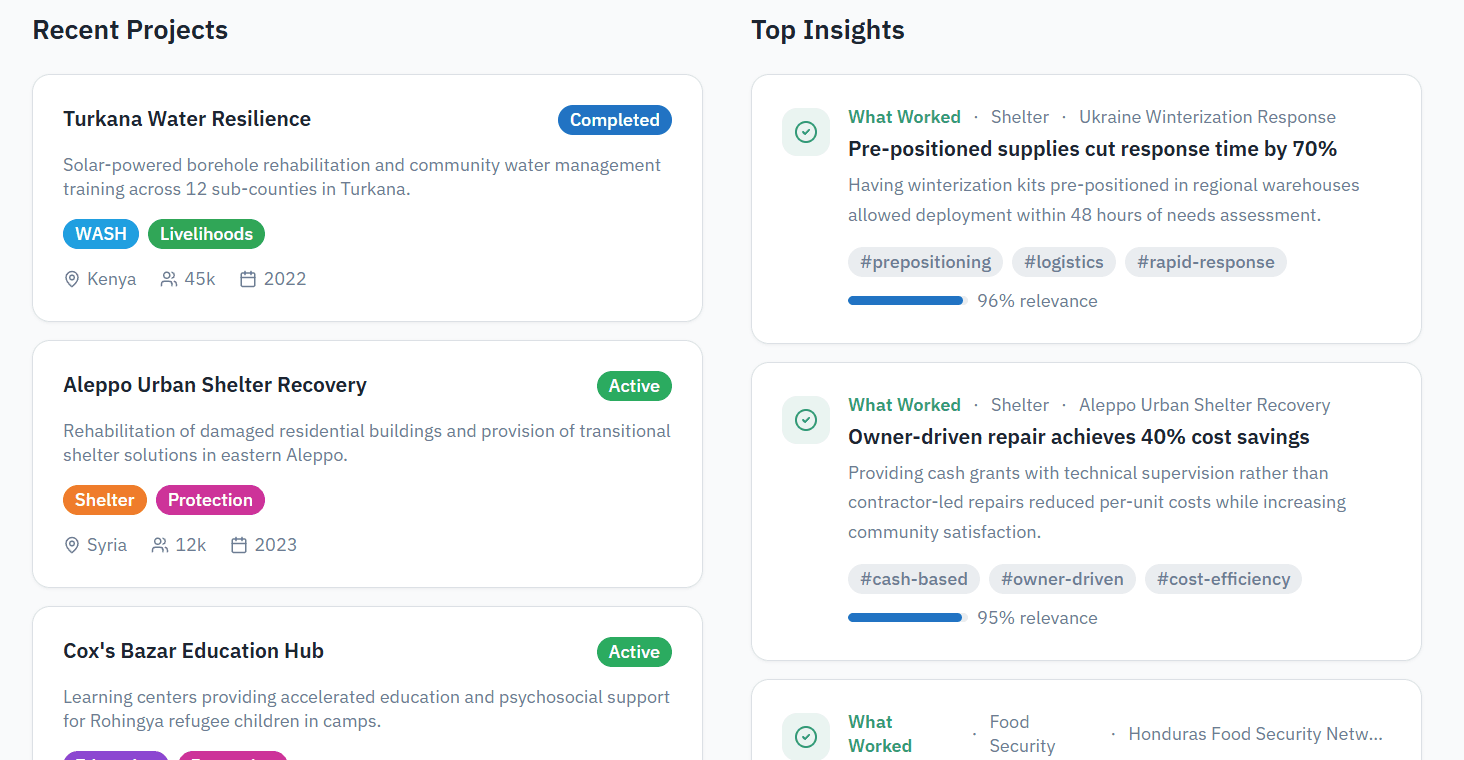
So, for each of these questions, we are collecting quarterly stories from everyone working on them about what they’ve observed, experiences, challenges they faced or new solutions they developed. In a monthly management meeting, we then come together to go through our key workstreams and goals together. As the documented lessons are connected to the goals we have, we ask the platform to compare the insights of the last months to the goals. It then produces a topic overview of the key insights found per goal, the challenges and the opportunities.

From there, we can further ask what recommended actions were noted by the team members to move forward.

Since the collective insights are already reflected against the goals, we can immediately evaluate and make sense of them in the meeting together, whether it makes sense to continue as we are or adjust the course of action to achieve our goals. If we then make a decision to change or try something new, we immediately plan a reflection activity in the system, which will remind us to come back to the decision and reflect on what the adjusted course of action has resulted in. Hence, we closed the feedback loop between what was planned, what happened in reality and whether it makes sense to continue as we are or adjust.
Closing the loop
This loop has been immensely helpful for us as a team to bring our insights together. We still look at metrics, but we combine them with the stories behind them. These stories show us why and how things worked or didn’t work.
By thinking of our strategy and plans as shorter, closed loops of planning, doing, reflection and learning, we feel much more confident in the decisions we are taking, and we have something to show for them. Whether internally to the team or externally to, for example, our advisors, we can show them why we took certain decisions and what happened along the way to achieving a goal. We therefore have a learning-evidence pathway to show which we can easily share.
The thinking process behind this cycle matters. The way we approached it and the pain point we felt of trying things felt like loose ends. The platform helps us in connecting the dots a lot more easily, and honestly, it’s fun to just dive into the universe of collective intelligence our team holds.